Forever and ever
Allison Lefrak and I connected through Substack several months ago and after reading a few of her posts I knew I needed to share her words over here on Inchstones. I was thrilled when Allison agreed. Today I am honored to share her heartbreakingly beautiful essay about parenting a teen with epilepsy, the impossible questions that arise, and finding new sources of hope when the old ones fail us.
---
“Why do I keep forgetting what I’m trying to say when I’m talking?” my fourteen-year-old daughter Abbie asked me recently. This happens frequently – it's as if her thoughts vanish before she can catch them. Sometimes it’s only a word that evades her, but other times she seems to forget what she was talking about altogether and she falls silent mid-sentence. In response, I explained that while everyone loses their train of thought sometimes, it happens more often for her because of epilepsy. She was quiet, and then she asked, “Do you like that I have epilepsy?”
My immediate thought was, God, no. I’m heartbroken that you have it. If I could have one wish, it would be that you didn’t have this dreadful disease. She stared at me expectantly as I fumbled through an answer: “No, I don't like that you have epilepsy, but it's not your fault. And I love you so much. I just wish it wasn't part of your life.” When I finished, she considered this for a moment. Then she offered the refrain she has said to me thousands of times: “I am yours and you are mine forever and ever.” I hugged her tightly. In that moment, she was the one comforting me.
I continued to worry about how I answered her question. I felt guilty for so desperately wanting to change something about her. Epilepsy robbed her of the future she once had. While it was a gradual shift after the onset at age seven, she evolved into a different person. My healthy, happy, and fiercely independent little girl was gone, replaced with a teenager who needs help with almost everything.
When Abbie was in second grade, she wandered out of gym class into the pouring rain in a daze and was sick outside. She had been mysteriously ill for about a month, and the teacher's account of how vacant she appeared was enough to send me to Children's Hospital the next morning. Two days, two MRIs, an EEG, and a spinal tap later, we left with a diagnosis but no cause: idiopathic epilepsy. The vomiting, we now understood, had been seizures all along.
“This just happens in kids sometimes, often around this age,” the neurologist explained in that first meeting at the hospital. He then turned to the subject of premature death in children with epilepsy explaining that a leading cause is seizure-related accidents like drowning. Without pausing, he switched gears entirely and said breezily, “Sometimes kids outgrow this and it goes away in puberty.” I latched onto that possibility like a life raft. For the seven years that followed, I held onto the belief that just as suddenly as the disease appeared, it might someday disappear.
As Abbie cycled through more than fifteen anti-seizure medications, none of which controlled her seizures, she was robbed of one thing after another — first soccer and bike-riding, then her closest friends and her ability to succeed in school. When people asked how she was doing and I felt strong enough to answer honestly, they went quiet. To fill the silence, I would add, “But it may go away when she goes through puberty.”
Statistics I found online suggested many children outgrow the condition in their teenage years. I imagined that one day the seizures would just stop. And while she would have much catching up to do academically, my focus could finally shift from fighting for seizure control to supporting her through that process. But over the past year, as Abbie went through puberty and her epilepsy only got worse, that conviction slowly crumbled.
As I lay next to her in bed, I asked about her field trip to an aquarium. She lit up as she started to recount the trip, but stopped suddenly when she could not conjure the word 'shark.' She was tired, and she didn't even attempt to keep going with the story. I kissed her goodnight and left the room grieving for the thoughts trapped inside her, unspoken. But I keep coming back to what she says: I am yours and you are mine, forever and ever. And that is what carries me.
You can follow Allison's journey with her daughter Abbie on Instagram @amlefrak, and on Substack: https://allisonlefrak.substack.com/
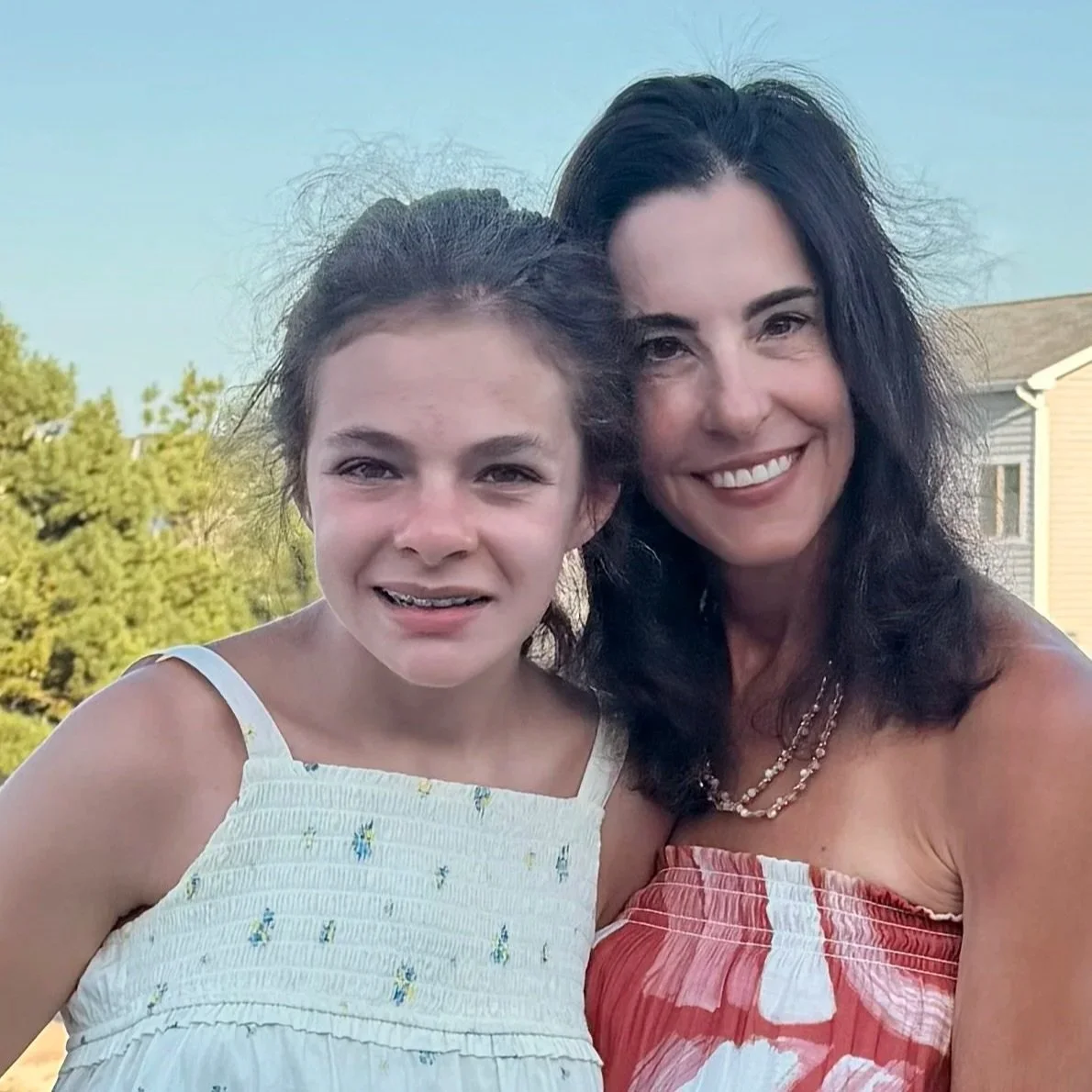
ID: 14yo Abbie wearing a white dress with flowers and smiling with her arm around her mom, Allison who is wearing a strapless red, pink and white top. They both have dark hair, dark eyes, and tan skin.