
The teen speaks
If you have ever parented teenagers, specifically the kind that respond with grunts before 11am and one-word answers after, then you know that when a teenager chooses to tell you something about their day you stop everything and listen. So, when my fourteen-year-old son, Jackson, started telling me about an interaction he had with two girls in one of his classes, he had my full and undivided attention.
A bit of background you’ll need for this story: education today, even in the classroom, is done almost entirely online through whatever platform the school district pays for. These platforms have replaced traditional textbooks and are used to assign and submit homework. They can also be used to communicate with each other during class – think of it like passing notes but without any physical evidence. Also, two middle schools feed into our high school.
Ok, so we were eating dinner at home a couple weeks ago when the heavens opened, the seas parted, and Jackson decided to share with us.
“My teacher was going on about something that had nothing to do with what we were learning about, and I saw these two girls I know in a Google doc, so I opened it,” Jackson explained.
Now picture me doing everything I can not to chastise him for not listening to his teacher because I NEED to know where this story is going. “Do I know them?” I asked. This was dangerous – asking too many questions (any questions really) can scare the teenager off.
“No, they went to the other middle school. So they figured out that Dad was Hamilton, and then they found this photo online of me as a little kid kissing Dad’s cheek and you were holding Adelaide.”
“Mmhmm,” I responded, using every ounce of nonchalance in my system.
“They asked about my sister. I told them I had two sisters, but that Adelaide in the picture had died. They didn’t believe me and were giving me all this crap about how I was lying.”
At this point, I am trying so hard to play it cool. Seriously, I deserve a medal or something.
“I told them it was true, and that my mom had written two books about her and they should look it up. They did and started freaking out. It was crazy. They wouldn’t stop apologizing and kept saying how bad they felt and how sorry they were for bringing her up.”
Do not say anything, Kelly! Especially don’t mention how much you love that he told them about your books. Say nothing!
“I told them it was ok, that I like talking about Adelaide, but they wouldn’t stop apologizing. I forget sometimes that not every family talks about death and grief as much as our family does.”
I wanted to know what he had been thinking when this was going on. How their response had made him feel. How he wishes they would have responded. If it would affect the way he mentioned his sister to anyone in the future. But I refrained. Too many questions could impact his desire to tell me anything else in the future.
“Most kids haven’t lost someone really close to them yet. They don’t know how to respond when confronted by death. Unfortunately, adults aren’t much better.” I said instead of everything I wanted to ask him.
“Yeah, it was weird.”
And then dinner was over and I lost him back to the dark hole that is his bedroom.
But I couldn’t stop thinking about this exchange. And how Jackson, for the rest of his life, would experience conversations like these with varied responses. Obviously, I wish that Jackson wasn’t so familiar with grief but also child grief is not as rare as people would like to think.
According to the Child Bereavement Estimation Model, 1 in 11 children will lose a parent or sibling by the age of 18. That number doubles by age 25. That means in a typical school class of 20-30 kids there are 2-3 kids who have experienced or will experience a significant loss.
Here is where I get to shout out our state of New Jersey and our local child and family grief organization Good Grief NJ, for passing the first of its kind law requiring grief education for students grades 8-12th. Though, after my son’s interaction I have to wonder how well our district is doing with incorporating this mandate.
As uncomfortable as it makes us, some children are going to experience grief. It is up to the adults in the room to educate themselves on how to best support a grieving child. But it is also up to parents of non-grieving children to not shy away from talks with their kids about death.
Learning that death and grief are taboo topics starts in childhood. It is up to parents to dispel the stigma and teach kids that death is part of life. Because if my kid is resilient* enough to live through it, then your kid is resilient enough to learn about it.
Oh, and happy child grief awareness month :)
(Posted with Jackson’s permission)
*You can read HERE about what I think of the adage “kids are resilient”.
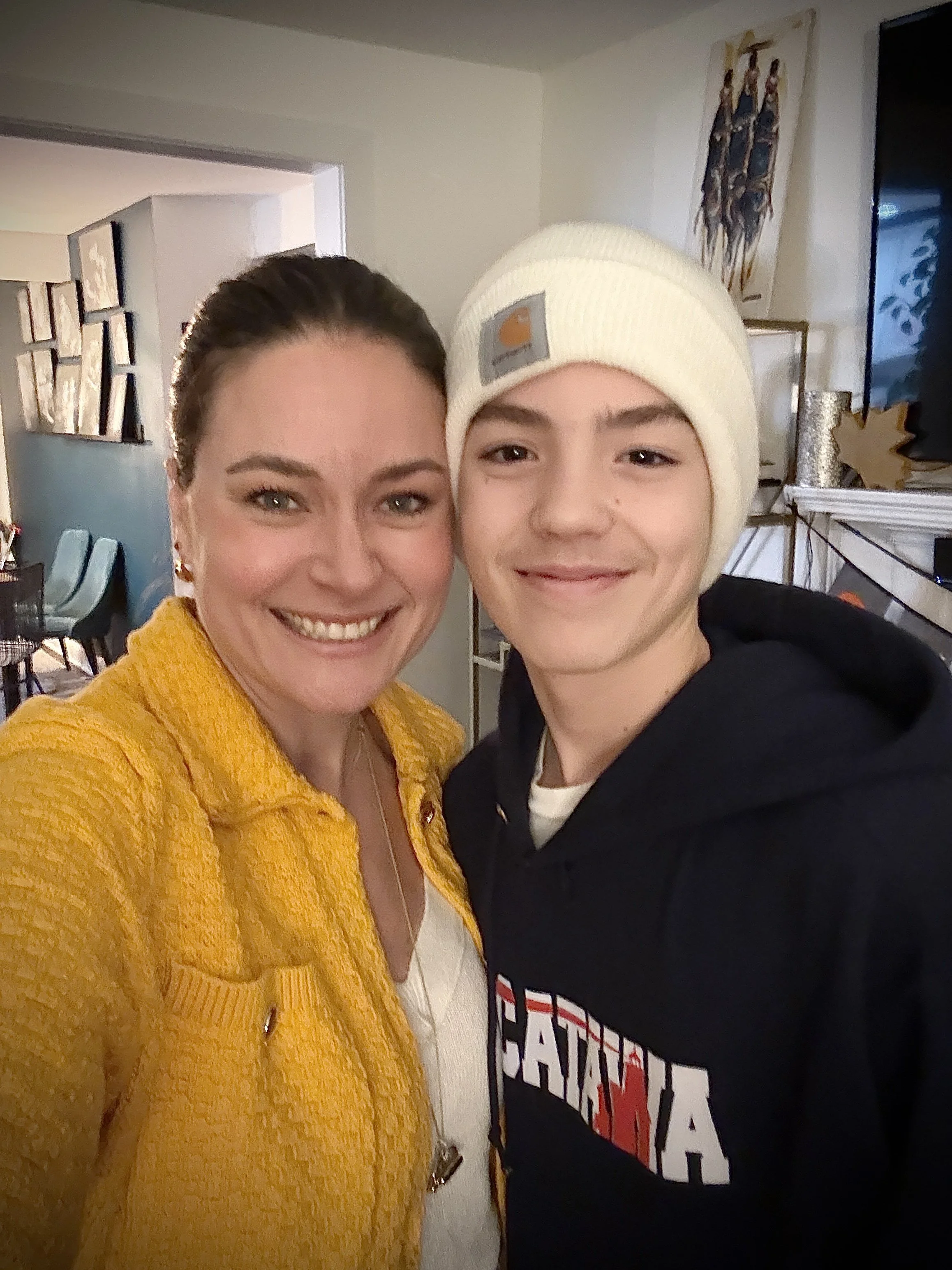
ID: Kelly and Jackson smiling at the camera in their living room. Kelly's hair is pulled back and she is wearing a yellow sweater. Jackson is wearing a white beanie and black hooded sweatshirt.