In honor of Purple Day
Happy Friday! In honor of yesterday’s Purple Day (an epilepsy awareness day), I’m changing up my usual format this week and posting an interview with Dr. Ashlyn Sanders, an awe-inspiring woman who has invented PATI, an FDA approved medical device that is already helping prevent oral injury in epilepsy patients across the country. Not only is Dr. Sanders a pediatric neurology resident at Johns Hopkins and an inventor, but she also has lived experience.
In her early 20’s Dr. Sanders was diagnosed with Chiari malformation which occurs when brain tissue extends into the spinal cord. While there are treatments, there are no cures. Unfortunately, after one of those treatments, brain surgery, Dr. Sanders began to experience seizures.
Thankfully, after several years on anti-seizure medication she was able to gain seizure control and wean off medication. However, not before Dr. Sanders experienced the harsh reality of life with seizures, including the anxiety of not knowing when the next seizure would occur, exhausting postictal periods, and in particular, oral injury.
Ok, enough background from me, time to meet Dr. Sanders…
How has being a neurology patient impacted your neurology education and training?
Being a neurology patient reinforced my belief that while physicians can do so much at the bedside, many of the barriers patients face are driven by broader issues of access, systems, and policy. That perspective is a major reason I chose this field.
One of the clearest gaps I have seen in medicine is that our system is often organized around curing disease, controlling disease, or reducing major clinical events, but not always around addressing the daily quality-of-life burdens that persist when a condition is chronic, incurable, or not fully controlled. In epilepsy and other neurological diseases, many patients do not achieve complete seizure freedom, and even when treatment is optimized, they and their families may still live with the constant burden of injury risk, fear, disruption, and loss of independence. Those day-to-day realities can be deeply consequential, yet they have historically been under-addressed in product development and clinical care.
While I am HUGE proponent for research, quality of life is also imperative. Tell us about the PATI device and what inspired you to create it?
My diagnosis put me on a path I could not have anticipated, one that has shaped my perspective. PATI, or Protector Against Tongue Injury, is the first FDA-cleared prescription rescue device designed to help protect seizure patients from oral injury during seizures. PATI is also meaningful in name: it is the first four letters of “patient”.
How does it work?
PATI is designed to be administered prior to the tonic phase of a seizure or during aura and it has been FDA-cleared for inpatient, outpatient, and first responder use. Like an EpiPen or seizure rescue medication, PATI is a device that a patient or caregiver can carry in a portable, tear-away pouch wherever and whenever a seizure may occur.
But isn’t the current medical advice not to put anything in the mouth of someone who is seizing?
Historically there have been no practical, patient-centered solutions designed specifically for oral injury – until PATI. Oral injury during seizures can be physically painful, emotionally distressing, and disruptive to recovery. Creating PATI was my response to that unmet need. It is a device born from personal experience, informed by clinical insight, and built to meet a real need that too often goes unaddressed.
Being an entrepreneur while in residency is wild! How do you manage your own health while keeping up with your professional responsibilities?
It has definitely required a great deal of intentionality, discipline, and perspective. For me, managing my health while keeping up with medicine and entrepreneurship has meant being very deliberate about structure, boundaries, and support systems. I try to stay anchored in routines and practices that allow me to function at a high level over time, rather than just pushing through in the short term. It also means recognizing when to lean on others, when to pace myself, and when to prioritize recovery so I can continue showing up fully in each role.
I do not think of it as balancing everything perfectly, but rather as continuously recalibrating. Starting the company before medical school, leading it through FDA clearance during medical school, and now continuing that work while training in pediatric neurology has required a strong sense of purpose and an ability to stay grounded in why the work matters. For me, that purpose has always come back to patients, families, and the realities of living with illness.
I’m exhausted just thinking of about doing all of that. What have been some of the greatest and most challenging moments about bringing a medical device to market?
Bringing PATI from what was initially little more than a napkin concept to an FDA-cleared medical device was incredibly meaningful. Reaching that point was not just a business milestone; it was validation that a problem long overlooked in medicine was real, important, and worthy of a purpose-built solution.
Some of the most challenging moments came very early. Being a young, African American woman shaped how often I had to prove both the legitimacy of the problem and my own legitimacy as a founder and CEO. In many rooms, I was asking others to see beyond pattern recognition and conventional expectations of what a medical device founder is supposed to look like.
What kept me going through that period were the people who reminded me, again and again, that this problem was real. Even when PATI was still just a concept, I was receiving emails and phone calls from patients, mothers, fathers, sisters, and brothers asking—sometimes pleading—for the device. I saved those messages, and I would often go back and read them when I needed a reminder of why I had to keep going. Those voices made the mission impossible to walk away from.
There were also moments that made the need for PATI feel heartbreakingly concrete. Following a pitch competition a woman stopped to tell me that a device like this could have saved her brother’s life—he had choked on his own blood during a seizure and died. Encounters like these stay with me. They reinforce that this was never just about building a product; it is about addressing a serious and often overlooked source of harm for patients and families.
Dr. Sanders, thank you so much for your valuable time. I appreciate you and all the work you are doing to help improve the daily lives of epilepsy patients!
To learn more about PATI visit www.usepati.com.
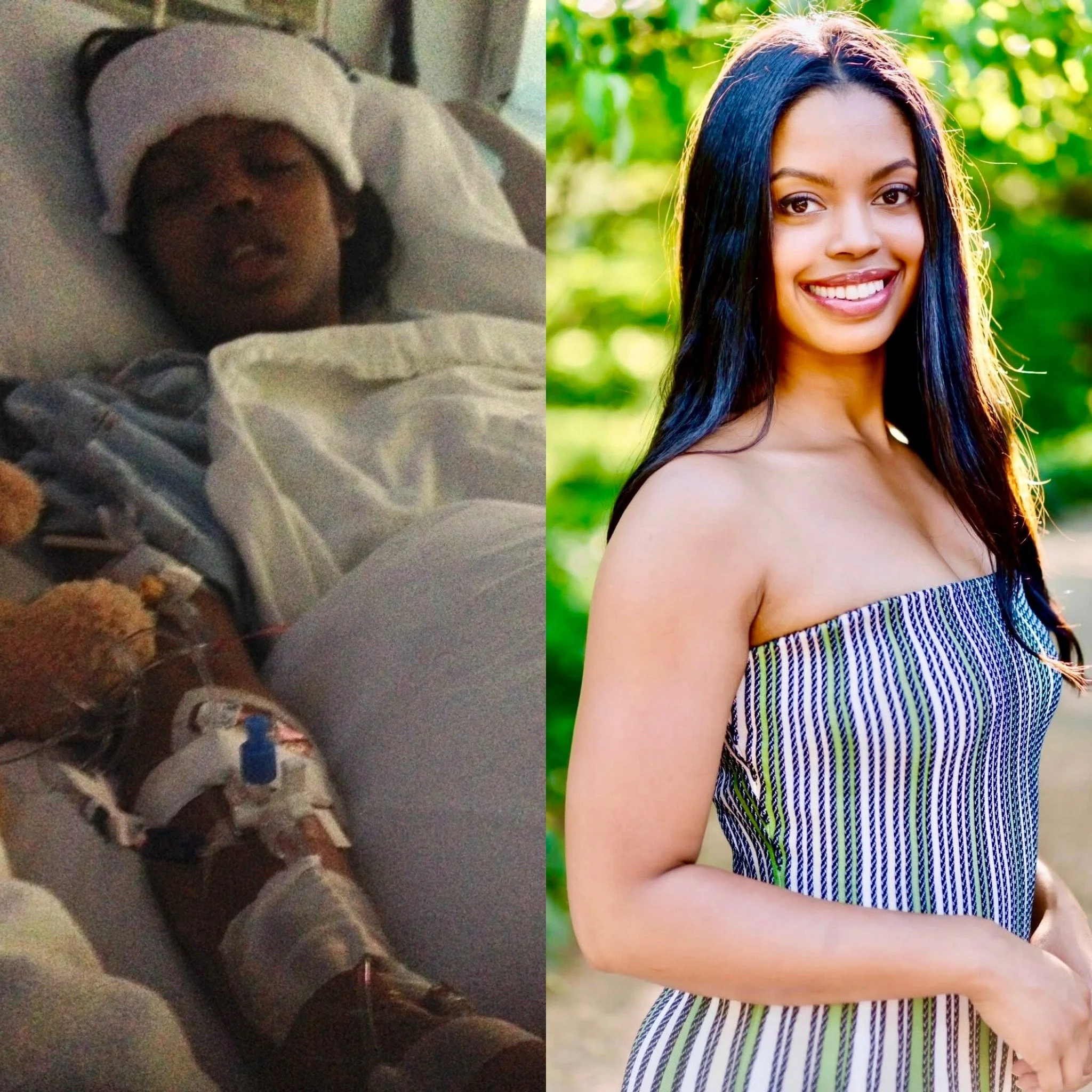
ID: Side by side photos of Dr. Ashlyn Sanders. On the left she is resting in a hospital bed with IV’s in her arm and a white cloth on her head. On the right she is smiling outside in the sunshine in a striped strapless dress.
DISCLOSURE: I am a strategic advisor to PATI’s parent company, Neurovice. This interview, as with all my writing, reflects my personal beliefs and interests and is separate from any organizations with which I am affiliated.