RIP textbooks
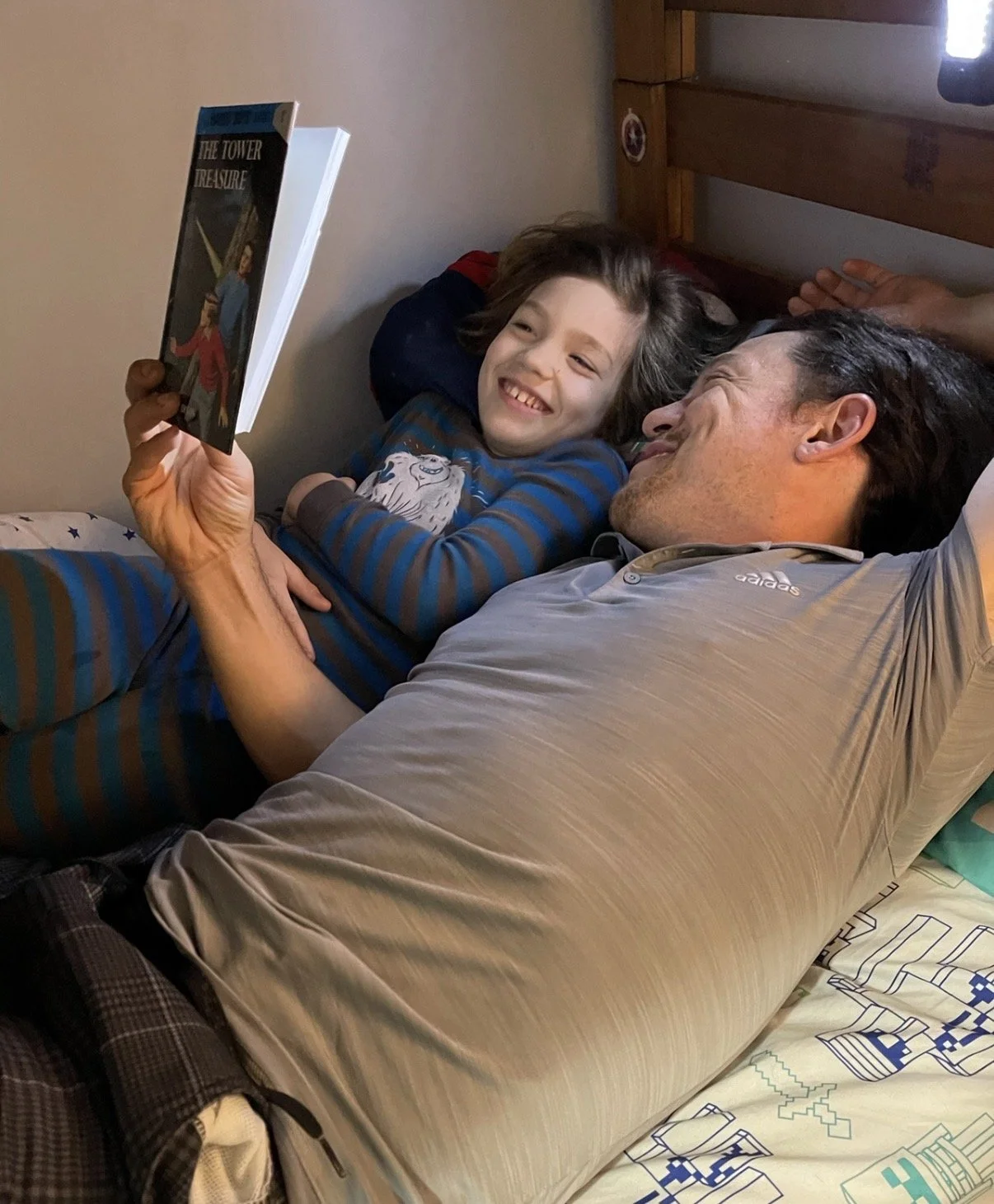
The attached photo is from a much happier time in the Cervantes household - back when books were read, discussed, and you know, generally existed. Excuse me for a moment as I vent about the American education system, specifically the complete and total use of online materials for teaching.
Miguel and I are not the parents who insist that our children get all A’s. However, we have also been very fortunate that up until recently our only child who receives real grades has done well in his classes.
Throughout his educational career, Jackson has experienced several learning curves where he’s needed to adjust the amount of effort necessary to maintain his grades. All students reach these educational roadblocks where their general intellect no longer cuts it and additional time and skills are required. Like learning how to study, for example. The tricky part as a parent is knowing when this is happening and then, once we are aware, how to help.
Our first hurdle with Jackson was getting him to ask us for help. For better or worse, he has grown up to be an independent kid. That behavior is easily traced back to Adelaide, specifically having a sibling with medical complexities. From an early age Jackson figured out how to do things on his own, from getting a snack to accessing his iPad to getting ready for bed. With Miguel at the theater and Adelaide requiring so much care, he grew up faster than most, as siblings in his situation often do.
In many ways this is great, he is typically a responsible and trustworthy kid. The problem though, is that he is also far less likely to ask for help. Even when he really needs it as we discovered after two poor test grades this year. It just doesn’t even seem to occur to him as an option. Which simultaneously drives me crazy and breaks my heart.
However, once Miguel and I realized that additional support was needed we had our own learning curve to tackle: figuring out what in the heck he was actually studying in his classes.
Growing up I brought home my textbooks, covered in brown paper grocery bags, to study from and reference for homework. When I had questions, I could take the textbook to my parents and ask for help. Most kids today no longer have textbooks – everything is assigned through whatever virtual educational platform the school district has signed a contract with. It is through this website that all class lessons and homework is assigned, worked on, and submitted.
On the platform our district uses every teacher is able to create their own “classroom”. Meaning that no two classes use the platform the same. What is being taught, assigned, or scheduled is organized differently by every teacher. Additionally, once an assignment is submitted through the website it can no longer be viewed. Meaning it cannot be used to study from or to understand if there are concepts you didn’t get right on the homework. To that end, because exams are done through these online platforms as well, they are not brought home for parents to see after the fact.
Throw in a teens desire to do the bare minimum and a generational technology gap and you end up with two parents and one teen arguing over what is being taught, what is expected of the student, and how in the world we are supposed to be able to help.
It reminds me of when “new math” was introduced, and we had to learn a whole new way of teaching elementary math concepts. Except this is not just a different way of learning a particular topic it is a whole new way of educating our students. And I get it from a financial perspective – I imagine the school districts are saving money on not buying textbooks or printing out worksheets, quizzes and tests. But is there a bigger cost?
We have all seen the reports about how American students are not testing as well as in past decades. The decline in test scores is often blamed on screen time and poor attendance since COVID. However, I can’t help but wonder if it is also because we have over virtualized education making it difficult for students to easily access information and particularly challenging for families to assist students at home.
Is there an additional benefit to having a physical textbook or paperwork that you can reference and study – or is that just what I am used to? Could this simply be a generational issue and when our children become parents will be a non-issue for them? I don’t know the answers, and I would love to hear a teacher’s perspective on this. But what I can say is that in our house we would really love to know exactly what the chapter 8 test is going to be on so we can help the teen with the developing frontal lobe and a lack of executive functioning skills not fail his next test.
Please and thank you.
ID: Miguel reading a Hardy Boys book to Jackson (age 9). They are laying next to each other in Jackson’s bed on top of his Minecraft sheets and laughing at the book. Jackson is in pj’s and Miguel is wearing a grey t-shirt and dark shorts.